Why BaZi Calculators Disagree: A Step-by-Step Comparison
Different BaZi Day Masters or pillars? Compare calendar input, recorded time, day rollover, birthplace corrections and interpretation with worked examples.

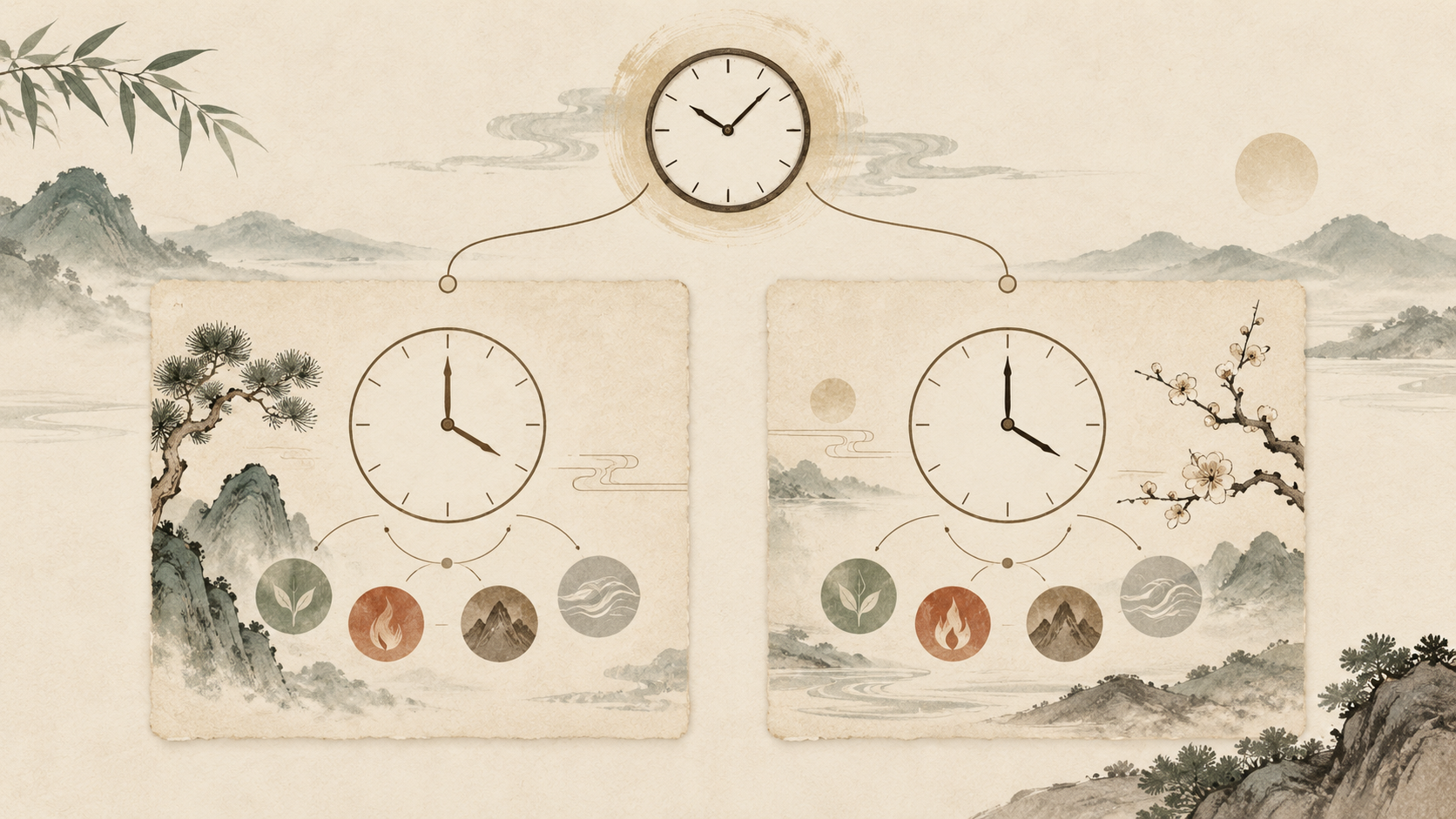
Two BaZi calculators can return different results because their input dates, time corrections or day-change rules differ. They can also agree on the pillars and disagree only in interpretation. Compare the characters and settings first; a confident personality description does not prove a better calculation.
This guide separates those differences with fictional examples. Start with the Day Master tool for a clock-time day-stem check, then use full BaZi when birthplace correction is relevant. Keep the calculation basis instead of comparing screenshots with settings cropped out.
Find the first field that differs
Write down whether the difference is in the year, month, day, hour, Day Master, strength label or Luck Pillar start age. A different year pillar and a different day stem call for different checks.
If all four stem-branch pairs match, the calendar calculation has agreed for that input. “Strong Jia” versus “weak Jia” is then a difference in analysis, not evidence that the day stem changed. The Jia Wood guide explains the chart context those labels need.
Check 1: calendar and civil date
Confirm that both tools expect a Gregorian date. Entering a lunar birthday in a Gregorian field changes the input. Lunar conversion also needs the correct year and leap-month status. BaziPal's quick tool expects Gregorian dates and has no lunar entry mode.
Check what a record means by “midnight.” The night between two dates cannot be resolved by choosing whichever produces a preferred chart. Preserve the original wording and establish the civil date before adjusting anything else.
Check 2: day-change convention
Zi spans 23:00 to 01:00 in the Hong Kong Observatory's stem-branch reference. That two-hour division is not itself an instruction that every calculator must change its Day Pillar at 23:00.
BaziPal's quick tool uses midnight for its main result. For a provided 23:xx time, it shows a 23:00 comparison using the library's alternative sect setting. Try 1990-06-08 at 23:30:
| Day-change rule | Day Pillar | Day Master |
|---|---|---|
| Midnight, main result | 甲辰 | Jia / Yang Wood |
| 23:00, comparison | 乙巳 | Yi / Yin Wood |
Both rows retain the same recorded input. Neither applies birthplace or solar correction, and this is not an alternative full chart. On the following civil date, 1990-06-09 at 00:00, the main result is 乙巳. These examples check a configured convention, not which interpretive school a person should use.
Check 3: local time, historical offset and DST
Use the recorded local time and the same birthplace before comparing corrections. Today's regional offset may not describe a historical birth date. IANA's documentation explains local-time and daylight-saving changes, with limits in historical coverage.
Ask whether each tool accepts the original civil time or an adjusted time. If it handles daylight saving itself, subtracting it before entry can apply the adjustment twice. Do not convert a local record to Beijing time unless the tool asks for that convention. Record each adjustment so the comparison can be reproduced.
Check 4: true solar time and birthplace
Clock time and true solar time need not give the same effective hour. Longitude and the equation of time can move the calculation across a boundary. The true solar time tool shows that correction separately.
The quick Day Master calculator has no birthplace field and applies no solar correction. Full BaZi can use the location data provided to its engine; inspect the returned basis to see what was applied. A nearby city may change longitude or the selected time zone, so retain the selected location rather than treating it as interchangeable with the birth town.
Check 5: year and month boundaries
January 1, Lunar New Year and Li Chun are different boundaries. BaziPal's BaZi convention uses Li Chun for the year and the relevant month-opening Jie for the month. A month pillar is not selected simply from a Gregorian month number.
The Hong Kong Observatory's solar-term explanation supplies the astronomical framework. A specific borderline birth needs the relevant year's transition instant in a consistent time zone. “Always February 4” does not give that instant. The Chinese zodiac guide covers the related year-label question.
Check 6: unknown time and interpretation
A blank time, a documented noon birth and a noon placeholder are different states. A blank in the quick tool gives a disclosed provisional reference and no Hour Pillar. If another tool fills in a complete hour, compare its assumptions before interpreting it.
For ranges, see the unknown and borderline birth-time guide. Matching day stems do not establish matching hour information. Even matching pillars do not guarantee matching strength, useful-element or Luck Pillar start-age methods.
Keep a comparison receipt
Save calendar, civil date, recorded time or unknown status, birthplace, effective time, corrections and day-change rule alongside the returned pillars. If a tool does not expose a setting, record it as unknown rather than assuming agreement.
The quick tool's downloadable receipt contains its actual scope: date, time status, reference time, Day Master, Day Pillar, convention and limits. It is not a complete chart export or a record of corrections it never applied. Read the calculation method before using it as a reference.
Frequently asked questions
One calculator says Jia and another says Yi. Is one wrong?
Not necessarily. Check the date and midnight-versus-23:00 rule, especially for a late-night record. A correction crossing a day boundary can matter too. If the stated inputs and rules match, investigate the implementation rather than the personality descriptions.
Both show Jia but disagree on strong or weak. What should I compare?
Match all pillars and time assumptions, then compare seasonal support, roots, interactions and weighting. The quick tool does not give a strength verdict; it identifies the reference day stem.
Does a different Hour Pillar mean a different Day Master?
Not always. For fictional 1990-06-08 clock inputs 08:55 and 09:05, the full engine gives 戊辰 and 己巳 hours while retaining 甲辰 as the day. Crossing an hour boundary can leave the day stem unchanged.
Which result should I use next?
Use the result whose input and convention you can explain for the question at hand. Keep unresolved settings visible. Calendar agreement does not prove a personality or future prediction.
How this guide was created
Published by BaziPal with AI-assisted drafting and editing. Product scope and fictional examples were checked against the current engine and Day Master endpoint. This guide has not been independently reviewed by a credentialed BaZi practitioner. Sources support calendar and time-zone mechanics, not predictive accuracy. Corrections can be sent using the privacy policy contact details, with the article URL and passage.