Chinese Zodiac for January Birthdays: New Year or Li Chun?
Born in January or February? Compare Chinese New Year with Li Chun using 1990 and 2020 examples, then check which boundary your zodiac calculator uses.

To find your Chinese zodiac for a January or February birthday, check which year boundary you mean. A lunar-calendar zodiac label changes at Chinese New Year. A BaZi year pillar commonly uses Li Chun, the Start of Spring. These are separate dates, so a birthday between them can carry different animal labels under the two conventions.
BaziPal's zodiac lookup uses Li Chun, consistent with its BaZi engine. That is the convention this tool computes; it does not make a lunar-calendar label incorrect.
Chinese New Year and Li Chun answer different questions
Chinese New Year is the first day of the first lunar month in the traditional lunisolar calendar. Li Chun is one of the solar terms. The Hong Kong Observatory's conversion tables list lunar dates and solar terms separately, letting you compare the two boundaries for a particular year.
If you are asking which animal year a family calendar or New Year celebration refers to, use its lunar-calendar boundary. If you are checking a BaZi chart, read the chart's stated year-pillar convention. January 1 is not a substitute for either boundary.
Worked example: a January birthday in 1990
The 1990 HKO calendar places the first lunar month on January 27 and Start of Spring on February 4. Consider the hypothetical date January 30, 1990, away from either boundary day.
- With Chinese New Year as the boundary, the new Horse year has begun.
- With Li Chun as the boundary, the previous Snake year still applies.
Someone using BaziPal will therefore see the Li Chun-based Snake label for that date. Someone checking a lunar calendar can correctly see Horse. The difference is the convention, not the person's birthday.
The 1990 year page describes the Metal Horse year using the site's solar boundary. Read that label together with the boundary rather than assuming every day from January 1 belongs to the same zodiac year.
Worked example: 2020 began at two different boundaries
The 2020 HKO calendar places Chinese New Year on January 25 and Li Chun on February 4. For the hypothetical birthday January 30, 2020, the lunar-calendar animal is Rat, while the Li Chun-based year pillar remains Pig.
For a birthday comfortably after both boundaries, such as February 10, the animal year agrees under both conventions. These examples use dates away from the boundary itself; they do not establish an exact solar-term time.
How to check your own birthday
- Write your complete Gregorian birth date. If your record uses a lunar date, convert it carefully, including any leap-month detail.
- Decide whether you need a lunar-calendar zodiac label or a BaZi year pillar.
- Look up Chinese New Year and Li Chun for your birth year in a reliable calendar.
- Compare your birthday with the boundary used by the tool.
- If you were born on the solar-term day, compare the exact instant in the appropriate timezone. A table listing the date alone is not enough for that case.
Keep a note of the convention alongside your animal. “Horse, lunar-calendar boundary” is more informative than a bare label when comparing two websites.
What the year element adds
The year combines a Heavenly Stem and Earthly Branch; the animal follows the branch. The HKO explanation sets out the repeating sixty-pair cycle. Element labels such as Metal Horse belong to that year combination.
A year element is not automatically your Day Master, which comes from the day pillar of a full chart. Use the year-element guide for that distinction. Animal and element labels are traditional calendar and interpretive categories, not a measurement of a person's character.
Frequently asked questions
Does everyone born in January use the previous animal?
Under a Li Chun boundary, January is before the year's Start of Spring. Under a lunar-calendar boundary, a late January birthday may already be after Chinese New Year. Check the year's actual dates.
Is Li Chun another name for Lunar New Year?
No. It is a solar term. Chinese New Year begins the first lunar month; the two dates can differ.
Do I need my birth time to find my animal?
Usually a date is sufficient away from the chosen boundary. On the Li Chun day itself, the exact solar-term instant and birth timezone can matter.
Is one calculator necessarily wrong if the labels differ?
No. Check the stated boundary, date conversion, and timezone first. If both claim the same rules and still disagree, then investigate the arithmetic or calendar data.
A label you can explain
For Chinese zodiac January birthdays, record the date and boundary together. Use BaziPal's Li Chun-based lookup for its chart convention and a lunar calendar when that is the label you need.
Chinese zodiac year labels at a glance
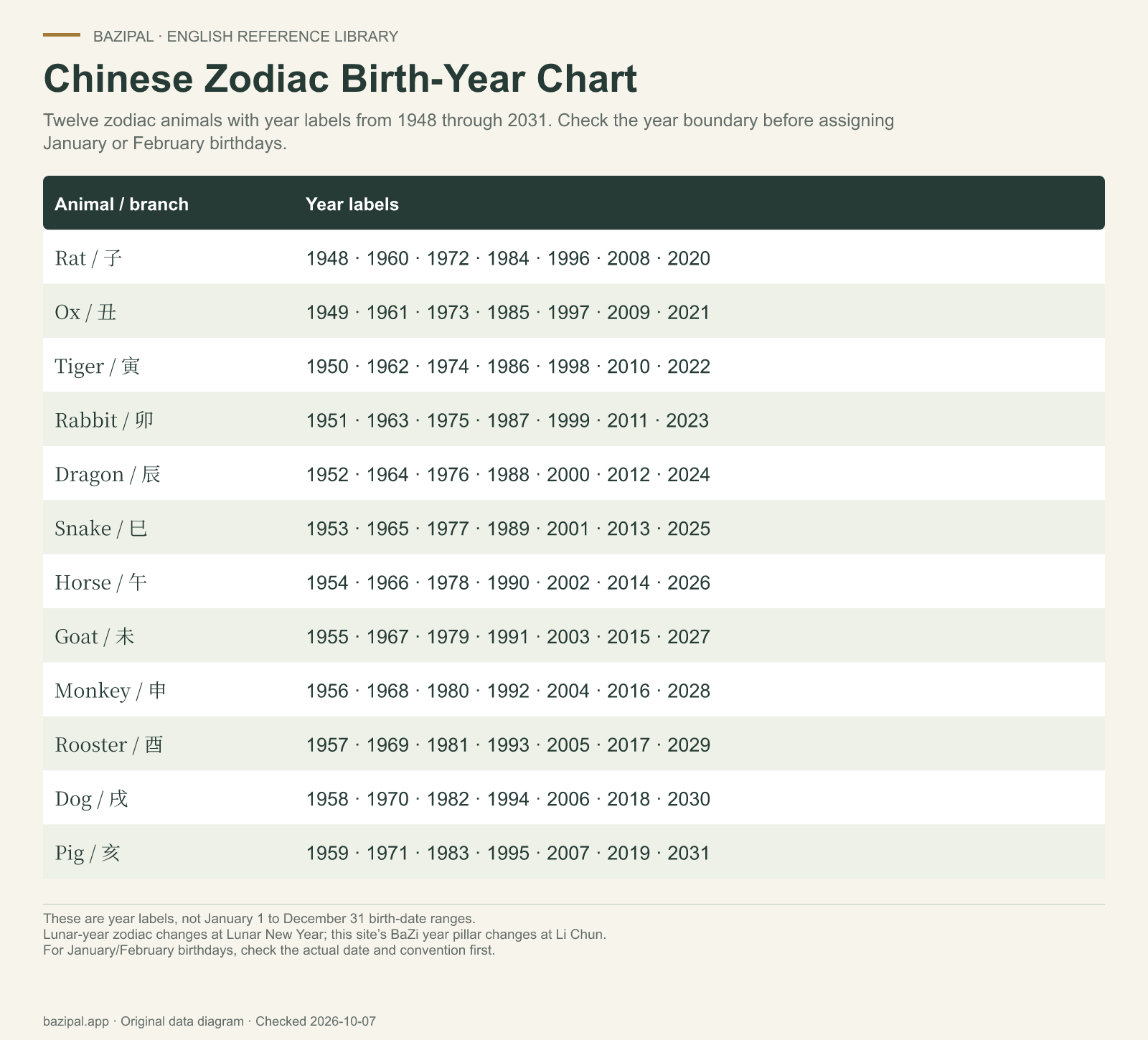
Chinese Zodiac Birth-Year Chart
Twelve zodiac animals with year labels from 1948 through 2031. Check the year boundary before assigning January or February birthdays.
Download PNGDownload scalable SVGChart library
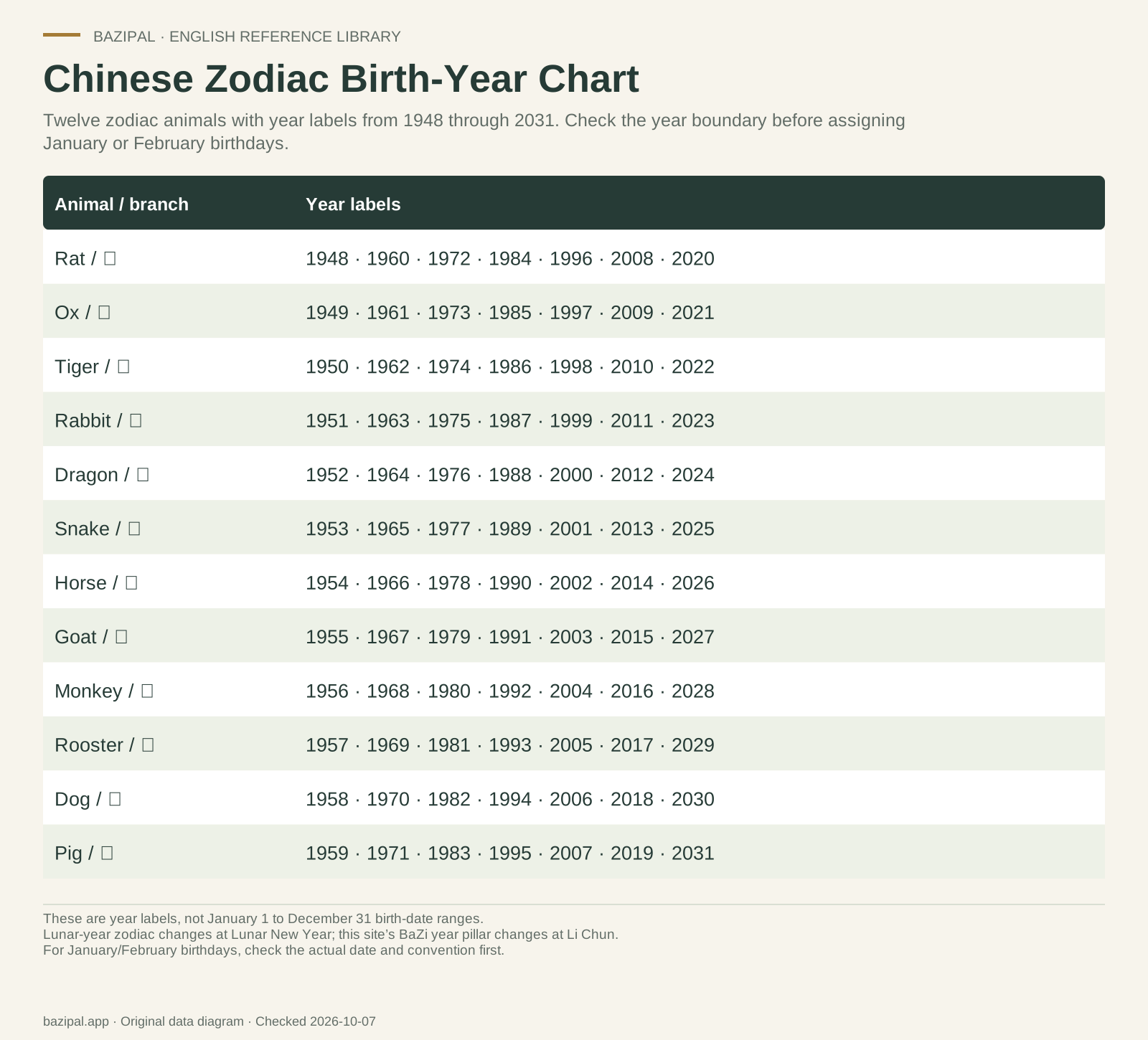
Read the chart as text
| Animal / branch | Year labels |
|---|---|
| Rat / 子 | 1948 · 1960 · 1972 · 1984 · 1996 · 2008 · 2020 |
| Ox / 丑 | 1949 · 1961 · 1973 · 1985 · 1997 · 2009 · 2021 |
| Tiger / 寅 | 1950 · 1962 · 1974 · 1986 · 1998 · 2010 · 2022 |
| Rabbit / 卯 | 1951 · 1963 · 1975 · 1987 · 1999 · 2011 · 2023 |
| Dragon / 辰 | 1952 · 1964 · 1976 · 1988 · 2000 · 2012 · 2024 |
| Snake / 巳 | 1953 · 1965 · 1977 · 1989 · 2001 · 2013 · 2025 |
| Horse / 午 | 1954 · 1966 · 1978 · 1990 · 2002 · 2014 · 2026 |
| Goat / 未 | 1955 · 1967 · 1979 · 1991 · 2003 · 2015 · 2027 |
| Monkey / 申 | 1956 · 1968 · 1980 · 1992 · 2004 · 2016 · 2028 |
| Rooster / 酉 | 1957 · 1969 · 1981 · 1993 · 2005 · 2017 · 2029 |
| Dog / 戌 | 1958 · 1970 · 1982 · 1994 · 2006 · 2018 · 2030 |
| Pig / 亥 | 1959 · 1971 · 1983 · 1995 · 2007 · 2019 · 2031 |
- These are year labels, not January 1 to December 31 birth-date ranges.
- Lunar-year zodiac changes at Lunar New Year; this site’s BaZi year pillar changes at Li Chun.
- For January/February birthdays, check the actual date and convention first.
References: Hong Kong Observatory · BaziPal method or guide
See the English chart and calendar library for all reference images and monthly downloads.
How this guide was created
This guide was prepared with AI assistance. Calendar facts and calculation rules were checked against the linked sources and BaziPal's current source code. It has not been independently reviewed by a qualified practitioner. Traditional interpretations are presented for reflection, not as evidence of future outcomes. For corrections, use the contact route in our privacy policy.