The Chinese Birth Chart, Explained for Beginners
A plain-English guide to the Chinese birth chart: what the four pillars mean, what a day master is, and how to read your own chart without the mysticism.
What a Chinese Birth Chart Actually Is
A Chinese birth chart is a map made from the moment you were born, built from your birth year, month, day, and hour. Each of those four points is called a pillar, and each pillar is described using two characters from an old Chinese calendar system, one representing a heavenly stem and one representing an earthly branch. Four pillars, two characters each, gives you eight characters total, which is why practitioners sometimes call the whole chart by that number.
You do not need to know Chinese astrology history to follow along. Think of it like a birth chart cousin to Western astrology, except instead of planets and zodiac signs, it uses repeating cycles of stems and branches, along with the five elements, to describe timing and temperament. The year pillar says something about your family and generation, the month pillar about your early life and career instincts, the day pillar about your core self and closest relationships, and the hour pillar about your inner world and later years.
Because the hour pillar depends on your exact birth time, charts can look different if you were born at 2 a.m. versus 2 p.m., even on the same day. That is one reason people find it useful to run their information through a free chart calculator rather than trying to calculate stems and branches by hand.
The Day Master: The 'You' at the Center
Inside your day pillar sits something called the day master, and it is arguably the most personal piece of the whole chart. The day master is one of ten heavenly stems, and each stem carries its own temperament, almost like a personality archetype. Some are steady and rooted, some are quick and adaptable, some prefer structure, some prefer motion.
People often start here because it feels the most immediately relatable, similar to how a sun sign works in Western astrology, though the mechanics behind it are different. If your day master is the wood stem called jia, for example, you might recognize the description immediately, or find that only certain parts feel true, which is normal and expected. You can see how this plays out in detail on an example day master page, where the traits, tendencies, and typical growth edges of that particular stem are laid out.
The point of learning your day master is not to put yourself in a box. It is closer to being handed a description and asked, does this fit, and if so, where, and if not, why not. That kind of honest comparison is often more useful than a perfect match.
The Five Elements and What Balance Describes
Every stem and branch in your chart is tied to one of five elements: wood, fire, earth, metal, or water. Your full chart usually contains a mix of these elements, and the mix is rarely even. Some charts lean heavily wood and fire, others lean metal and water, and most sit somewhere in between with one or two elements missing entirely.
When practitioners talk about an imbalance, they mean the chart shows a lot of one element and very little of another, not that something is broken or wrong. A wood-heavy chart might suggest someone who grows quickly and pushes forward, but who can also snap under too much rigidity. Add more earth, and that same forward motion might have more patience behind it. These are descriptive patterns, not verdicts, and the value is mostly in the noticing.
It helps to think of the five elements the way a nutritionist might think about food groups. A meal heavy on one thing and empty of another is not automatically bad, but it is worth being aware of, especially if you keep landing in the same emotional or behavioral pattern and want to understand why.
What This Chart Is For, and What It Is Not
A Chinese birth chart works best as a reflective tool. It can offer language for tendencies you already sense in yourself, and it can point to broad timing themes across different years or life phases, similar to how tarot spreads or feng shui readings work as prompts for reflection rather than instructions to follow blindly.
People often use their chart to think through questions like, why do I keep clashing with the same kind of person, or why does this particular year feel harder than most. Used that way, the chart becomes a mirror. It gives you texture and vocabulary, not a script.
What it is not for is prediction as certainty, and it should never replace medical, legal, or financial advice from a qualified professional. If a chart reading is telling you exactly what will happen to your health, your money, or your relationships with no room for your own choices, that is fatalism dressed up as insight, and it is worth stepping back from. The honest version of this practice always leaves room for the fact that you are the one living your life, not the chart.
How to Cast Your Own Chart in About a Minute
Casting your chart yourself is far simpler than it used to be. All you need is your birth date and, ideally, your birth time and location, since the hour pillar depends on precise timing. Enter the recorded details in the chart calculator and inspect the pillars supported by that input, together with the calculation basis. An unknown time does not supply a known Hour Pillar.
If the birth time is unknown, leave it unknown. The full engine omits the Hour Pillar rather than treating an approximate time as a recorded fact. Other pillars can remain provisional near day or solar-term boundaries. The unknown birth-time guide shows how to retain those limits; the calculator comparison guide helps check different results.
Once you have your chart in front of you, resist the urge to read it as a fixed verdict. Read it the way you would read a thoughtful personality summary from a friend who knows you well, some of it will land immediately, some of it will take longer to recognize, and a little of it might never fit at all. That mix is normal, and it is part of what makes this kind of reflection genuinely useful instead of just decorative.
FAQ
Is a Chinese birth chart the same as Chinese zodiac animals?
They're related but not identical. Your zodiac animal comes from your year branch alone, which is just one small piece of the full four pillars chart. The complete chart includes your year, month, day, and hour pillars, plus your day master and five element balance, giving a much more detailed picture than the animal sign alone.
Do I need my exact birth time to get an accurate reading?
A missing time leaves the Hour Pillar unknown and can leave day or solar-term boundary questions unresolved. Start with a provisional date-only result and its stated calculation rules; a later documented time may refine that result. A chart does not establish predictive accuracy.
Can a Chinese birth chart tell me what will happen in my future?
No, and any reading that claims certainty about your future should be approached with caution. The chart is best used as a reflective tool for noticing patterns and timing themes, not as a fixed prediction, and it should never replace professional medical, legal, or financial guidance.
Four Pillars diagram
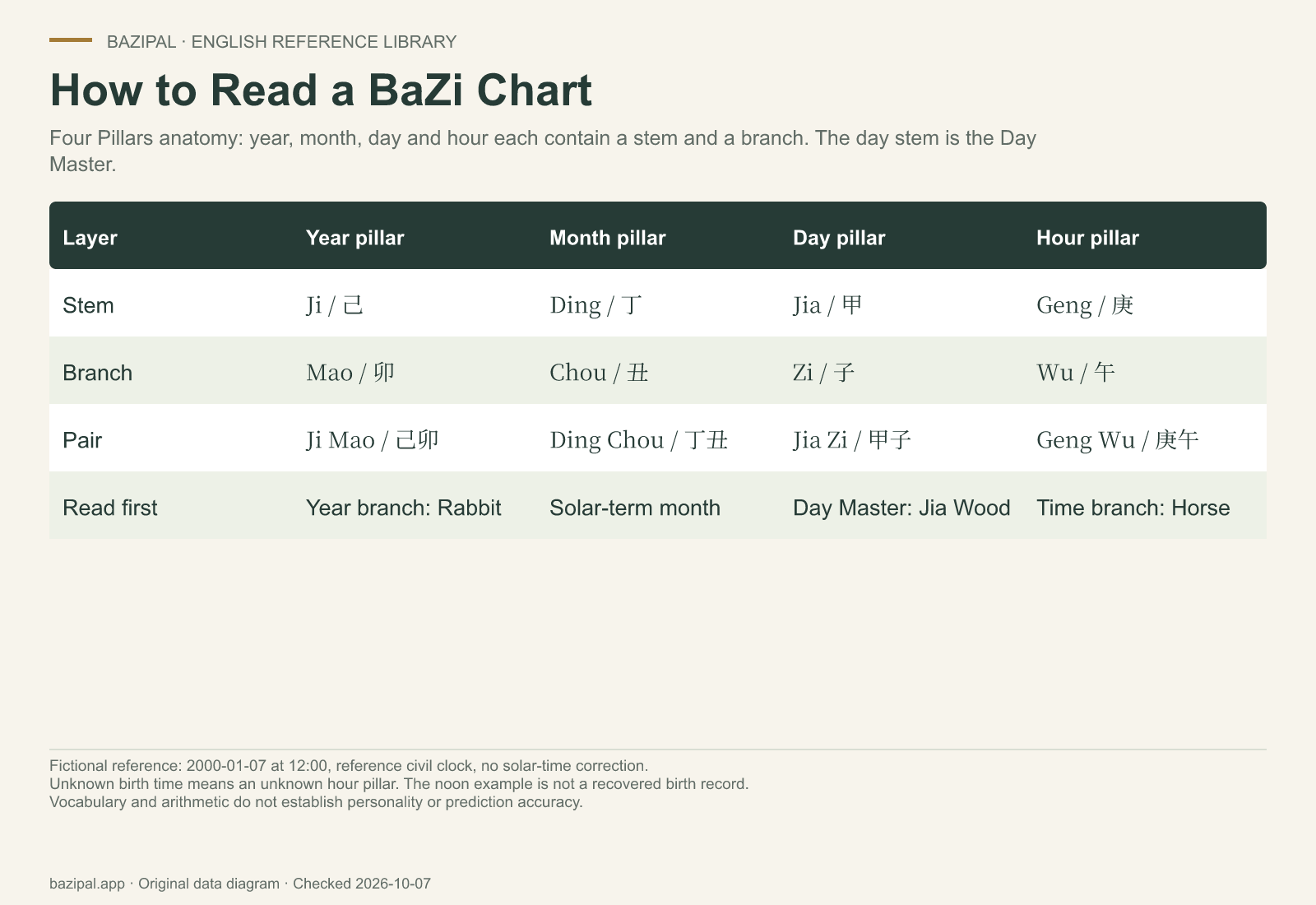
How to Read a BaZi Chart
Four Pillars anatomy: year, month, day and hour each contain a stem and a branch. The day stem is the Day Master.
Download PNGDownload scalable SVGChart library
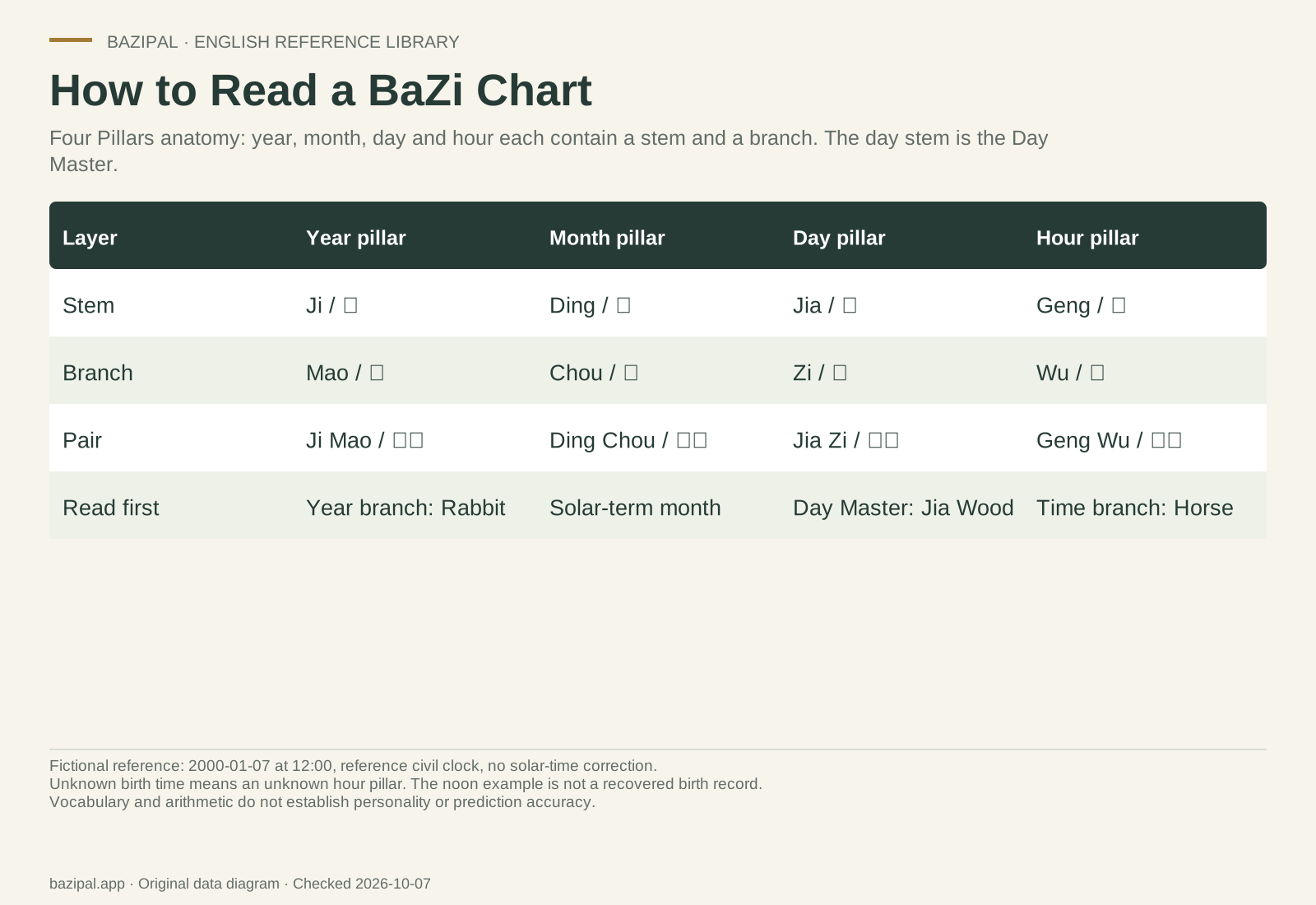
Read the chart as text
| Layer | Year pillar | Month pillar | Day pillar | Hour pillar |
|---|---|---|---|---|
| Stem | Ji / 己 | Ding / 丁 | Jia / 甲 | Geng / 庚 |
| Branch | Mao / 卯 | Chou / 丑 | Zi / 子 | Wu / 午 |
| Pair | Ji Mao / 己卯 | Ding Chou / 丁丑 | Jia Zi / 甲子 | Geng Wu / 庚午 |
| Read first | Year branch: Rabbit | Solar-term month | Day Master: Jia Wood | Time branch: Horse |
- Fictional reference: 2000-01-07 at 12:00, reference civil clock, no solar-time correction.
- Unknown birth time means an unknown hour pillar. The noon example is not a recovered birth record.
- Vocabulary and arithmetic do not establish personality or prediction accuracy.
References: Hong Kong Observatory · BaziPal method or guide
See the English chart and calendar library for all reference images and monthly downloads.
Update note
BaziPal used AI-assisted editing for this update to correct unknown-time wording and connect the troubleshooting guides. Calendar terminology can be checked against the Hong Kong Observatory; it does not validate personality or future predictions. This page has not been independently reviewed by a credentialed BaZi practitioner.