December 2026 BaZi Outlook: Great Snow, Winter Solstice and Review
Check December 7 Great Snow and December 22 Winter Solstice in 2026. Understand the Geng Zi month and plan year-end commitments before January 2027.
 BaziPal
December 2026 has two useful calendar checkpoints: Great Snow on December 7 and Winter Solstice on December 22 in the HKO calendar. BaziPal’s solar-month convention changes from Ji Hai to Geng Zi at Great Snow; Winter Solstice does not start another month. This outlook focuses on review, shared commitments, and the handover to January rather than forecasting the same outcome for every reader.
December 2026 calendar: Great Snow and Winter Solstice have different roles
The HKO 2026 calendar lists Great Snow on December 7 and Winter Solstice on December 22. In the month-opening convention used here, Great Snow starts the Zi month. Winter Solstice is the middle term of that solar month. Its astronomical meaning and its role in a BaZi month boundary should not be confused.
A date on the Great Snow boundary needs the exact instant and time zone. The noon examples below are kept away from the boundary date. Traditional season names do not supply the weather conditions at a reader’s location.
| December checkpoint | Calendar role | Reference month |
|---|---|---|
| December 1, noon | Before Great Snow | Ji Hai / 己亥 |
| December 7 | Great Snow | Exact solar-month transition. |
| December 8, noon | After Great Snow | Geng Zi / 庚子 |
| December 22 / 23 noon example | Winter Solstice / the following day | Still Geng Zi in this convention. |
Geng Zi as a monthly outlook, not a whole-chart verdict
Geng is the yang Metal stem; Zi is associated with the Rat and Water in this framework. A traditional reader can compare that pair with the natal chart and luck cycle. The label alone does not say that a person will earn more, lose a relationship, or need a particular cure.
The editorial planning theme here is to make commitments visible before the year ends. A clear record of unfinished work, available time, and shared responsibilities is more usable than assigning every December event to a Metal–Water story. The symbolism can guide questions without supplying the answers.
Early December: close the gaps before adding new plans
Make a list of work or household matters that have a real deadline. For each, record who needs to act and what is still missing. Distinguish a provider’s stated deadline from a self-imposed “finish everything before New Year” expectation.
Check confirmation messages for gatherings, bookings, renewals, and any shared spending already arranged. If a date changes, notify the people affected. This guide gives no official holiday timetable or local operating hours; verify those with the relevant current source.
Around Winter Solstice: use a review that does not turn into fortune fitting
A useful review has three parts: what happened, what you did, and what remains unresolved. If you keep astrology notes, preserve their original date and wording. A later event that resembles a broad sentence is not a measured prediction result.
For a fictional example, someone wanted to “improve teamwork” in November and held a meeting in December. The review can record whether responsibilities became clearer and whether follow-up work happened. It should not rewrite the original note as if it had predicted the meeting’s exact outcome.
For a gathering or travel plan, check the actual location’s conditions. The term “Winter Solstice” belongs to an astronomical calendar and does not guarantee snow, closure, or a safe journey anywhere.
What carries into New Year 2027?
January 1 changes the Gregorian year. It does not automatically change the BaZi annual pillar or end Geng Zi month in this reference convention. The 2027 calendar gives Minor Cold on January 5, Li Chun on February 4, and Lunar New Year on February 6. These are different checkpoints.
Move only the still-relevant tasks into January and assign each a clear next step. Carry over the supporting information rather than just a hope that next year will feel different. The New Year checklist turns this handover into specific checks.
For the December 2026 BaZi outlook, keep the calendar, symbolic interpretation, and actual decisions in separate notes. The November guide explains the preceding month; the 2027 annual outlook introduces the next year’s separate comparison.
Frequently asked questions
Does December 22, 2026 start a new BaZi month?
Not in the convention used here. Winter Solstice is the mid-month term; Great Snow opened Geng Zi earlier in December.
Is all of December 2026 Geng Zi?
No. The month changes at Great Snow on December 7. Earlier dates remain Ji Hai, and the boundary instant requires a time check.
Does New Year’s Day end the December solar month?
No. The next opening term is Minor Cold on January 5, 2027 in the cited HKO calendar.
December 2026 calendar in English
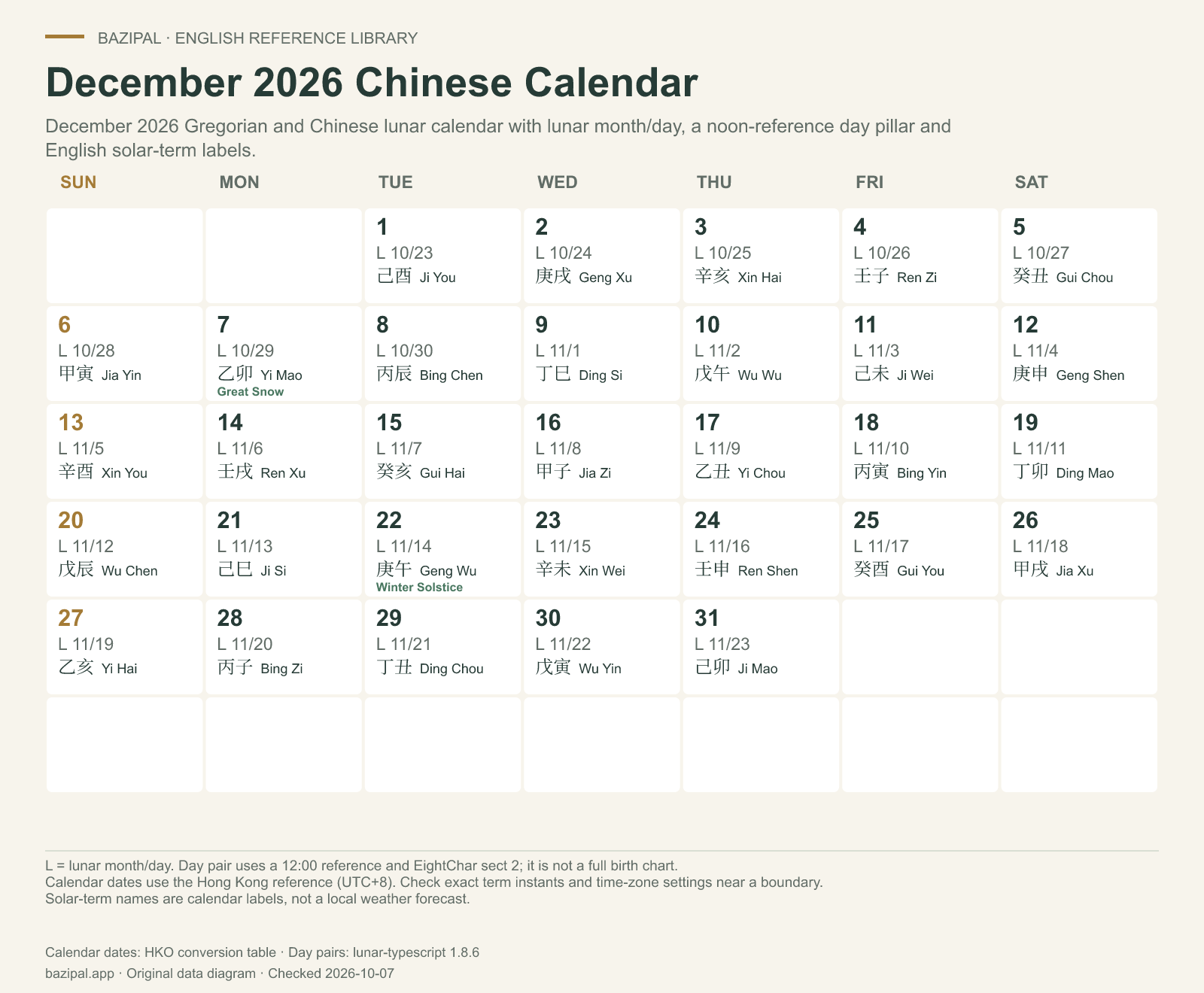
December 2026 Chinese Calendar
December 2026 Gregorian and Chinese lunar calendar with lunar month/day, a noon-reference day pillar and English solar-term labels.
Download PNGDownload scalable SVGChart library
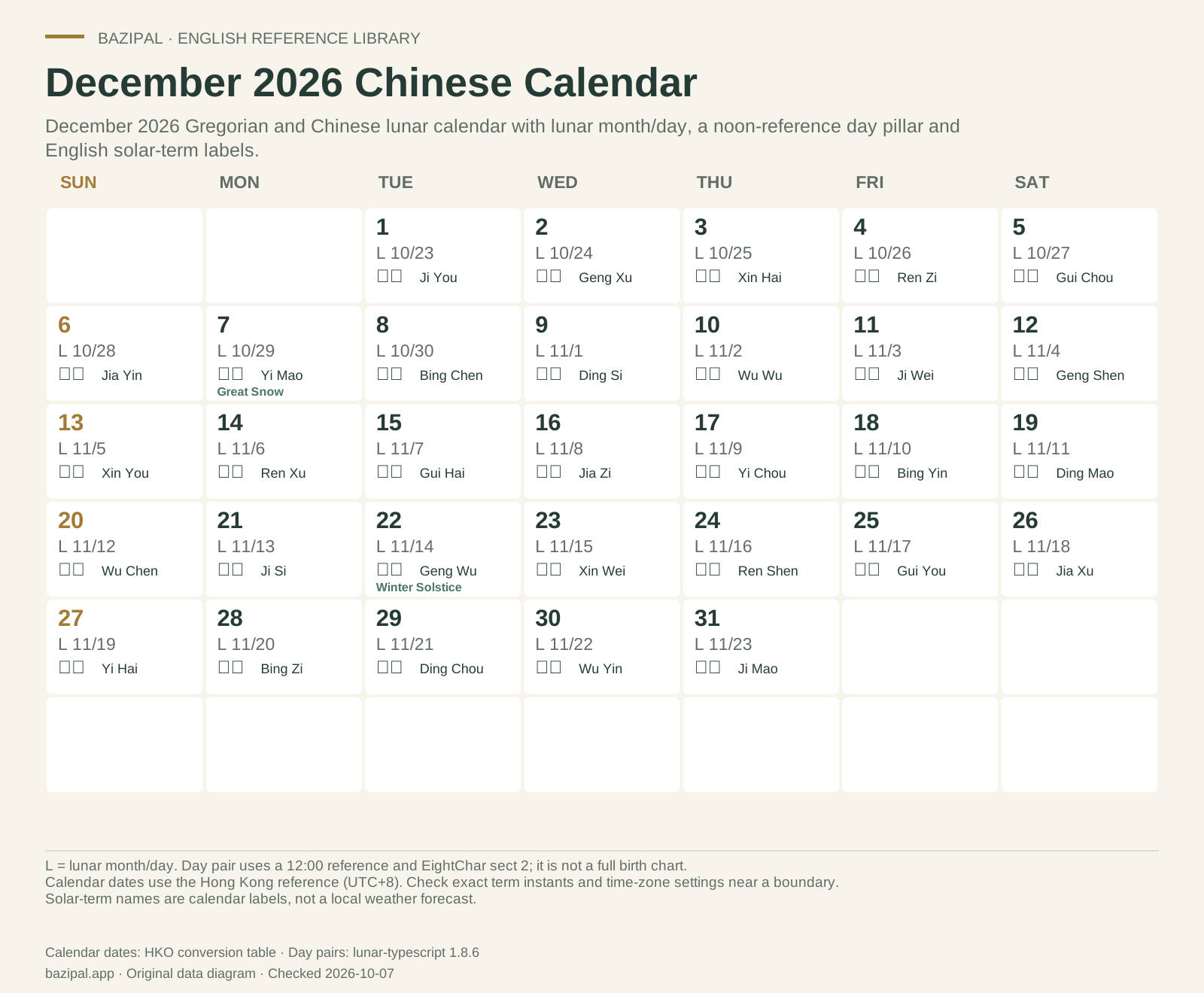
Read the chart as text
| Gregorian date | Lunar month/day | Day pillar at noon | Solar term |
|---|---|---|---|
| 2026-12-01 | 10/23 | 己酉 / Ji You | — |
| 2026-12-02 | 10/24 | 庚戌 / Geng Xu | — |
| 2026-12-03 | 10/25 | 辛亥 / Xin Hai | — |
| 2026-12-04 | 10/26 | 壬子 / Ren Zi | — |
| 2026-12-05 | 10/27 | 癸丑 / Gui Chou | — |
| 2026-12-06 | 10/28 | 甲寅 / Jia Yin | — |
| 2026-12-07 | 10/29 | 乙卯 / Yi Mao | Great Snow |
| 2026-12-08 | 10/30 | 丙辰 / Bing Chen | — |
| 2026-12-09 | 11/1 | 丁巳 / Ding Si | — |
| 2026-12-10 | 11/2 | 戊午 / Wu Wu | — |
| 2026-12-11 | 11/3 | 己未 / Ji Wei | — |
| 2026-12-12 | 11/4 | 庚申 / Geng Shen | — |
| 2026-12-13 | 11/5 | 辛酉 / Xin You | — |
| 2026-12-14 | 11/6 | 壬戌 / Ren Xu | — |
| 2026-12-15 | 11/7 | 癸亥 / Gui Hai | — |
| 2026-12-16 | 11/8 | 甲子 / Jia Zi | — |
| 2026-12-17 | 11/9 | 乙丑 / Yi Chou | — |
| 2026-12-18 | 11/10 | 丙寅 / Bing Yin | — |
| 2026-12-19 | 11/11 | 丁卯 / Ding Mao | — |
| 2026-12-20 | 11/12 | 戊辰 / Wu Chen | — |
| 2026-12-21 | 11/13 | 己巳 / Ji Si | — |
| 2026-12-22 | 11/14 | 庚午 / Geng Wu | Winter Solstice |
| 2026-12-23 | 11/15 | 辛未 / Xin Wei | — |
| 2026-12-24 | 11/16 | 壬申 / Ren Shen | — |
| 2026-12-25 | 11/17 | 癸酉 / Gui You | — |
| 2026-12-26 | 11/18 | 甲戌 / Jia Xu | — |
| 2026-12-27 | 11/19 | 乙亥 / Yi Hai | — |
| 2026-12-28 | 11/20 | 丙子 / Bing Zi | — |
| 2026-12-29 | 11/21 | 丁丑 / Ding Chou | — |
| 2026-12-30 | 11/22 | 戊寅 / Wu Yin | — |
| 2026-12-31 | 11/23 | 己卯 / Ji Mao | — |
- L = lunar month/day. Day pair uses a 12:00 reference and EightChar sect 2; it is not a full birth chart.
- Calendar dates use the Hong Kong reference (UTC+8). Check exact term instants and time-zone settings near a boundary.
- Solar-term names are calendar labels, not a local weather forecast.
References: Hong Kong Observatory · Hong Kong Observatory
See the English chart and calendar library for all reference images and monthly downloads.
How this guide was prepared and checked
BaziPal prepared this guide with AI assistance. Calendar dates were checked against HKO’s 2026 and 2027 tables; the stem-branch explanation supports calendar structure, and the solar-term explanation supports astronomical context. Site examples were cross-checked with lunar-typescript 1.8.6; the Ten Gods comparison follows the existing implementation. These sources do not validate fortune-telling or personality predictions. Editorial scenarios are fictional, and no practitioner review is claimed.